
Thinking with the Sea, 30 Sept. – 1 Oct. 2026, Forum Marinum, Turku
Text: Robert Louhimies
Images: Malla Lehtonen
Over two intensive days, researchers from many parts of the world gathered to discuss questions concerning water and the sea from a humanities perspective. Blue humanities is an interdisciplinary field of research that examines the relationship between humans and oceans, waters, coastlines, and marine environments, both historically and in the present day. Interest in the symposium was considerable, and not all of the many intriguing presentations could be accommodated in the program.
The symposium Thinking with the Sea – Interactions and New Perspectives Inspired by the Blue Humanities was opened by Patrik Henelius, Vice-Rector for Research at Åbo Akademi University, after which the first keynote speaker took the floor. Søren Frank, Professor of Danish and Nordic Literature at the University of Copenhagen, presented under the title “Think Blue: How Literary History Can Prepare Us for an Oceanic Future.” He highlighted the uncomfortable truth that humanity cannot stop climate change, only slow it down, and that we must therefore accept that our living conditions will change whether we want them to or not. According to Frank, literary history can help us prepare for this future.
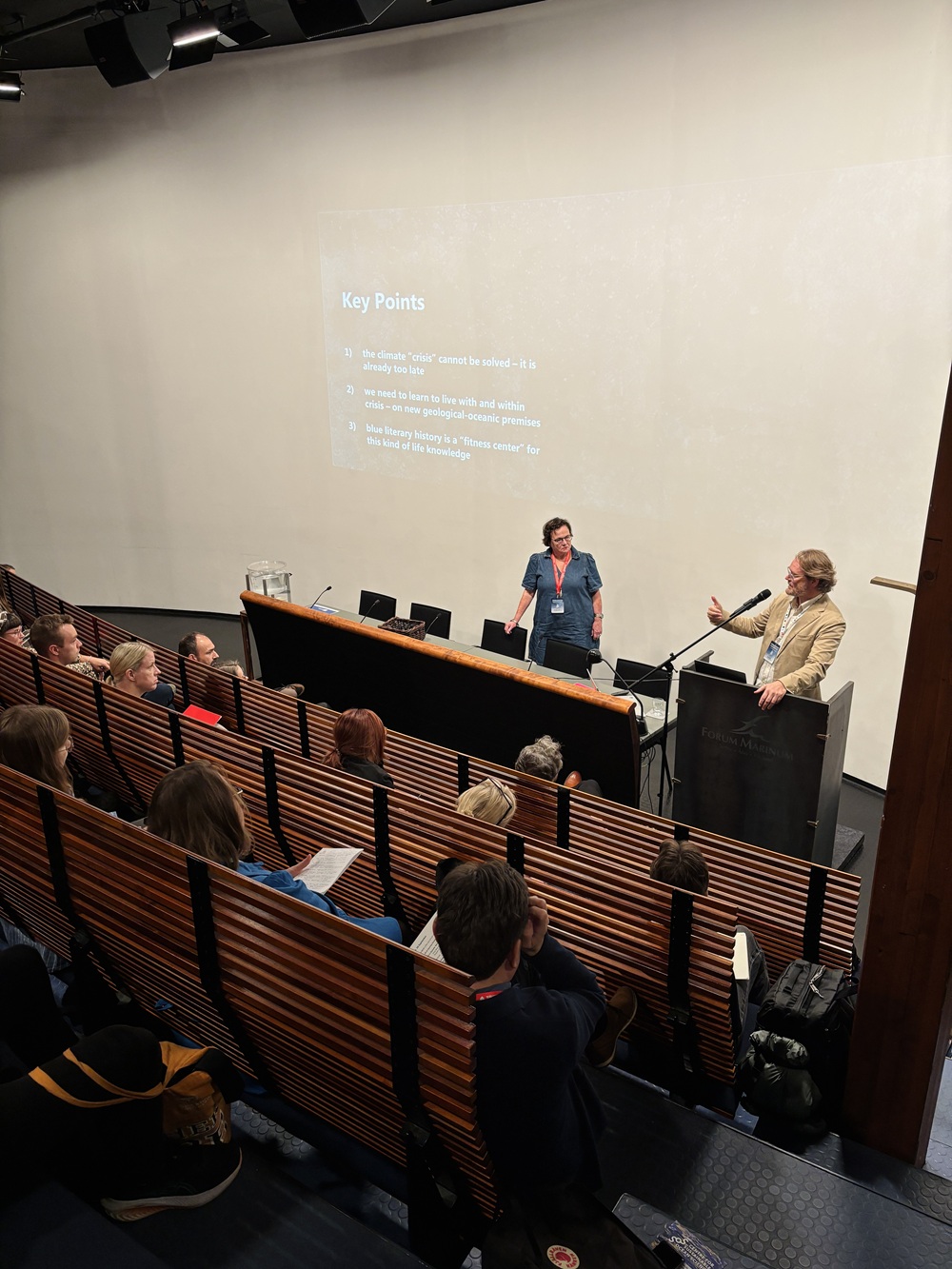
The symposium featured 36 presentations across ten sessions, covering a broad spectrum of themes relating to humanity’s relationship with water. During the first day, discussions addressed topics such as coastal life and island communities, maritime experiences in literature and art, the decolonization of maritime spaces, flight and migration by sea, and the role of the ocean as an actor in human narratives. Underwater worlds, marine animals, creative ways of representing the sea, sustainability issues, museum work, and visions of the future also shaped the programme. Altogether, the presentations emphasized the sea as a cultural, ecological, and existential force.
The second keynote lecture was delivered by Sabine Höhler, Professor of Science and Technology Studies (STS) at KTH Royal Institute of Technology in Stockholm under the title “Exploring the Ocean Anthropocene: Human-Earth Histories in Depth”. Speaking of the ocean in the Anthropocene, she explored the complex interplay between human activities and marine environments. Höhler discussed how research can integrate scientific, technological, historical, and humanistic perspectives in order to understand the changing oceans.
The discussions covered a wide range of issues, including the role of technology in generating knowledge about marine species, relationships between people and aquatic environments, languages and narratives connected to the sea, social and environmental injustices, island and coastal communities, and the possibilities for restoring damaged waterscapes.
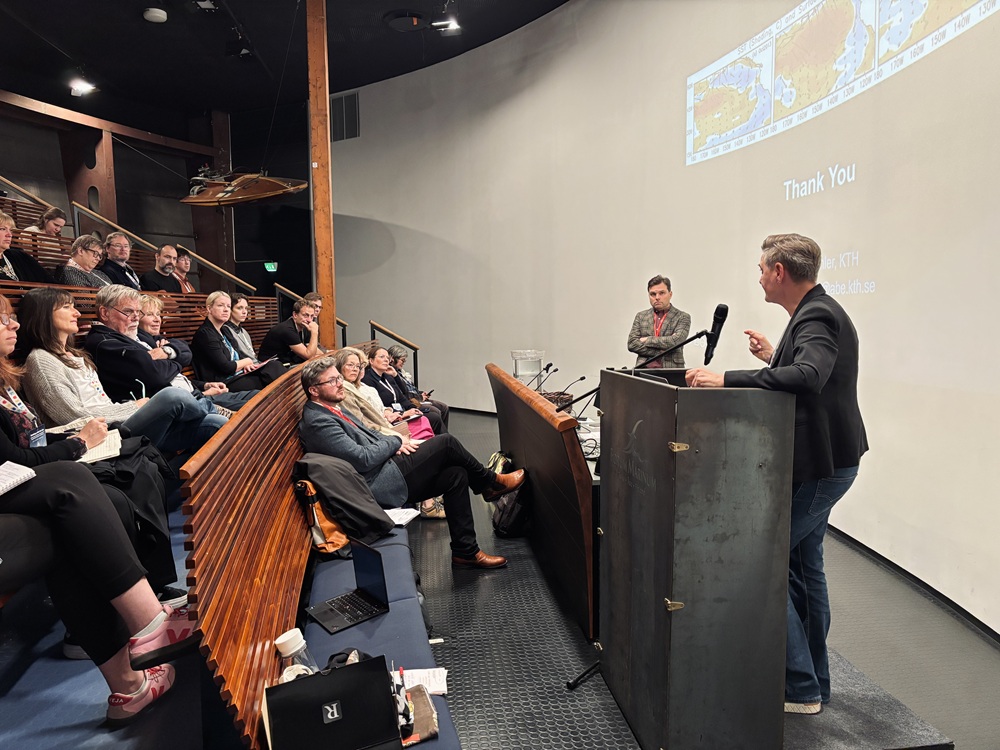
Thursday, and indeed the symposium as a whole, concluded with a panel discussion moderated by Otso Kortekangas, Title of docent and historian at Åbo Akademi University. Alongside the two keynote speakers, the panel also included Mia Österlund, Professor of Comparative Literature at Åbo Akademi University. The discussion revisited the symposium’s central themes and reflected on how the humanities and social sciences can contribute to future debates about the oceans. The panelists emphasized the importance of blue humanities, arguing that researchers must continually revisit earlier scholarship through new perspectives, and that concepts such as blue humanities provide valuable new lenses through which to study the sea. At the same time, they stressed the importance of intellectual modesty and interdisciplinary collaboration, encouraging researchers to look beyond their own disciplines and engage with the work of others, a principle that was, in fact, one of the symposium’s cornerstones.
In addition to interesting keynotes, presentations, and panel discussions, the program included a dinner at the Brewery Restaurant Koulu. Fittingly, in the Cygnaeus Cabinet, I had the opportunity to share a thematically relevant excerpt from Uno Cygnaeus‘s journey from Finland to Alaska in 1839:
We did not actually see Cape Horn itself. A small diversion was provided by the sight of whales in great herds, sometimes as many as fifteen or twenty at a time, as they majestically swam on all sides of the vessel, and occasionally like a team of horses drawing the ship from ahead.
They afforded us no occupation other than watching them, but it was quite different with a kind of bird called the albatross, which is found in incredible numbers around Cape Horn. They are as large as swans, though they do not have such long necks; instead, their wings are extraordinarily large, measuring five or six, and even up to eight cubits from tip to tip.
These birds are caught in a peculiar manner. One takes ordinary fishing hooks, naturally of considerable size, baits them with entrails or meat, and attaches cork floats to prevent the hooks from sinking. This equipment is fastened to a line thirty to forty fathoms long and allowed to trail behind the ship. Before long, an albatross strikes the hook with its large beak and becomes caught.[1]
The symposium was highly successful in every respect. The technology functioned smoothly, the schedule was maintained, the food was excellent, and the participants were satisfied. One fundamental reason for this success was the collaboration with the Centre for Sustainable Ocean Science (SOS), whose experience of organizing larger conferences proved invaluable. From the moment the Call for Abstracts was issued until the final minutes of the symposium, the organizing committee benefited from the steadfast support of coordinator Malla Lehtonen at SOS. In September, the committee was further strengthened by symposium secretary Emma Holmback. During the event, valuable assistance was also provided by the students Alexandra Obrey, Anniina Ruohomäki, and Jimi Lehtinen, as well as Reetta Sippola and Evelina Blom.
The symposium would not have been possible without the members of the organizing committee who, in addition to those already mentioned, included Anna Törnroos-Remes, Pia-Maria Ahlbäck, and Otso Kortekangas. Nor would it have succeeded without the financial support of the Federation of Finnish Learned Societies, the Swedish Cultural Foundation in Finland, the Society of Swedish Literature in Finland, the Waldemar von Frenckell Foundation, and the William Thuring Foundation.
By the end of the symposium, voices were already calling for a sequel. Perhaps there will be a Thinking with the Sea 2.0. Who knows?
Author
Robert Louhimies, Archivist, Institute of Maritime History at ÅAU
[1] Excerpt from a letter by Uno Cygnaeus to his mother, brothers, and sisters, 26 February 1840 (translation by Robert Louhimies), https://www.jyu.fi/tdk/museo/sitkaen.html, retrieved 9 October 2026.