
Attitudes towards immigration explain beliefs about asylum authorities and their decisions
Research has shown that media portrayals of asylum applicants influence public perceptions of asylum seekers. For example, asylum applicants may be depicted either as vulnerable individuals in need of protection or as a threat to societal resources. Such portrayals can shape how people think about asylum and the decisions made within the asylum process. However, while previous research has focused on the effects of media representations, little attention has been given to how individual characteristics and beliefs influence perceptions of asylum decision-making. The present study sought to address this gap by examining the individual factors associated with perceptions of the asylum process.
In the current Psych-Aid project, Jan Antfolk, together with Laura Stevens, Emilia Lundsten, Jenny Skrifvars and Hedayat Selim examined how personal immigration attitudes shape beliefs about asylum authorities and their decisions, and how these beliefs reflect well-established gender and age differences. Drawing on motivated cognition theory, the authors predicted that individuals with more lenient attitudes toward immigration would estimate that a lower proportion of asylum applications are accepted, perceive fewer accepted decisions and more rejected decisions as erroneous, and view asylum applicants as more truthful. In contrast, individuals with more restrictive immigration attitudes were expected to believe that a higher proportion of applications are accepted, perceive more accepted decisions and fewer rejected decisions as erroneous, and view asylum applicants as less truthful.
The authors also examined the roles of gender and age, drawing on evolutionary (i.e. men may be more protective against perceived out-group threats) and generational perspectives. Given evidence that men tend to hold more restrictive immigration attitudes, they hypothesised that men would report more negative views of asylum decisions and lower trust in asylum applicants’ truthfulness than women. Similarly, given the generational differences in immigration attitudes, younger respondents were expected to express more positive views of asylum decisions and greater trust in asylum applicants’ claims than older respondents.
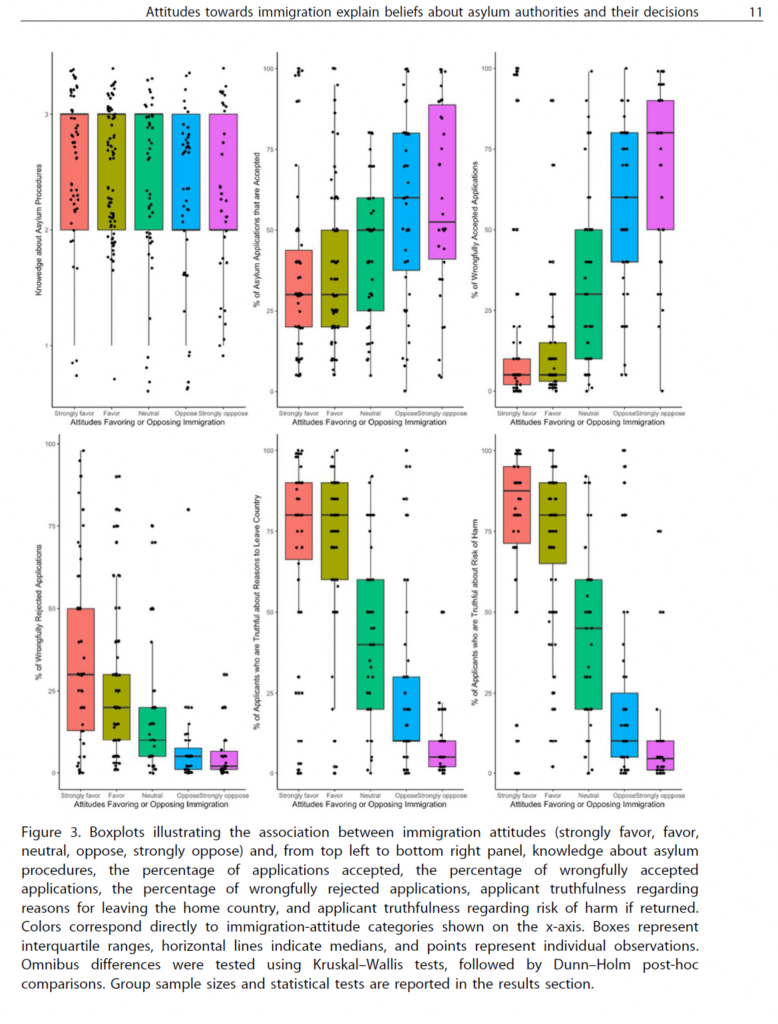
The study recruited 255 participants from Finland (128 women and 127 men), who completed a survey assessing their attitudes towards immigration, as well as their knowledge and beliefs about the asylum determination process. As expected, participants with more lenient attitudes toward immigration estimated that fewer asylum applications were accepted and reported lower estimates of wrongful acceptance, higher estimates of wrongful rejection, and greater perceived truthfulness of asylum applicants than those with more restrictive attitudes toward immigration (see Figure 3).
Gender differences were also observed. Men reported higher estimates of wrongful acceptance, lower estimates of wrongful rejection, and lower perceived truthfulness of asylum applicants than women. Men were also more likely to oppose immigration. Lastly, age was associated with several study variables. Participants aged 65 and older reported greater perceived knowledge than those aged 25 to 34. Respondents aged 55 to 64 reported higher estimates of wrongful acceptance than those aged 18 to 24. For wrongful rejection, participants aged 18 to 24 reported significantly higher estimates than older participants (25 and older). Similarly, younger respondents (18 to 24) perceived asylum applicants as more truthful than older participants (45 and older).
In line with motivated cognition theory, these findings suggest that ideological beliefs shape how individuals perceive and evaluate the asylum system. Rather than being based solely on factual information, perceptions of asylum procedures and outcomes may be influenced by underlying ideologically motivated beliefs. These results highlight the importance of addressing motivated cognitions and ideological biases when seeking to correct misconceptions about the asylum system, as providing factual information alone may be insufficient.