

An Experimental Test of Stereotype Congruency
in Credibility Assessments of Sexual Orientation
Asylum Claims
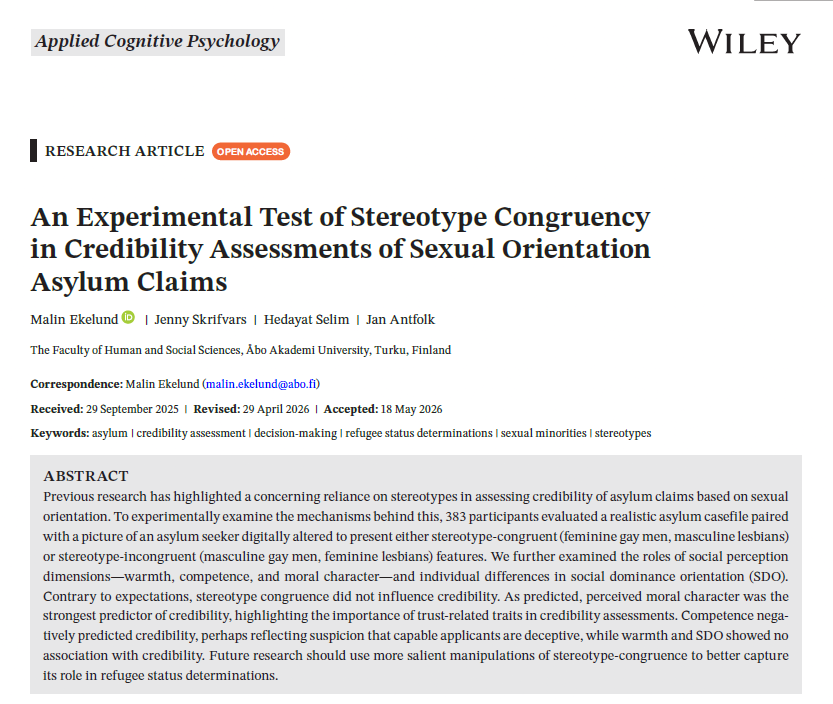
Individuals with diverse sexual orientations, gender identities, or gender expressions (SOGIE) are recognised by the United Nations High Commissioner for Refugees as members of a particular social group. Consequently, they may be eligible for international protection if they have a well-founded fear of persecution in their country of origin based on their sexual orientation. One of the key responsibilities of asylum officials in such cases is to assess the credibility of applicants’ claims. Although previous research suggests that these credibility assessments may be influenced by stereotypes, the specific psychological mechanisms underlying such judgements remain unclear.
In this Psych-Aid project, Malin Ekelund, together with Jenny Skrifvars, Hedayat Selim, and Jan Antfolk, sought to better understand the psychological mechanisms underlying credibility assessments in sexual orientation asylum claims. To investigate this, they conducted an experiment examining whether stereotype congruence—that is, the extent to which an applicant appeared consistent or inconsistent with stereotypes associated with gay men and lesbian women—influenced credibility judgements.
The study recruited 383 participants, who evaluated a realistic asylum case file accompanied by a digitally altered photograph of the applicant and rated the applicant’s credibility, warmth, competence, and moral character. In addition, the researchers measured participants’ social dominance orientation (SDO) to examine individual differences in attitudes toward social hierarchy and group-based inequality.
The results showed that stereotype congruence did not affect credibility judgements. Instead, perceived moral character emerged as the strongest predictor of credibility, indicating that trustworthiness-related impressions play a central role in how asylum claims are evaluated. Competence showed a negative association with credibility, suggesting that more capable-seeming applicants may be viewed with greater suspicion. Warmth and SDO were not significantly related to credibility. See the figure below for a summary of the study’s finding.
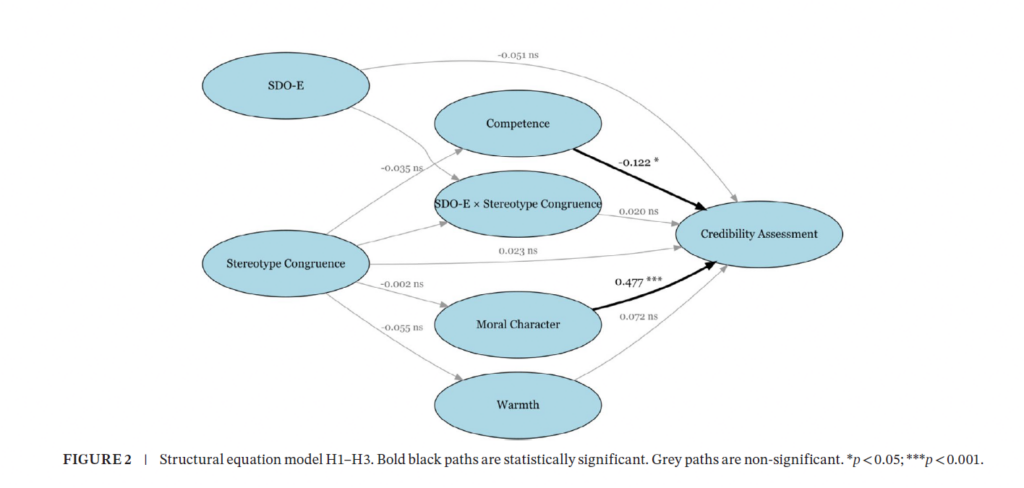
The findings suggest that, while appearance-based stereotyping may occur in real asylum proceedings, it may be more subtle than a simple match-or-mismatch effect. The study calls for future research using more powerful or ecologically valid manipulations of stereotype congruence and highlights the importance of addressing how impressions of trustworthiness—which can themselves be shaped by bias—influence asylum decision-making.