

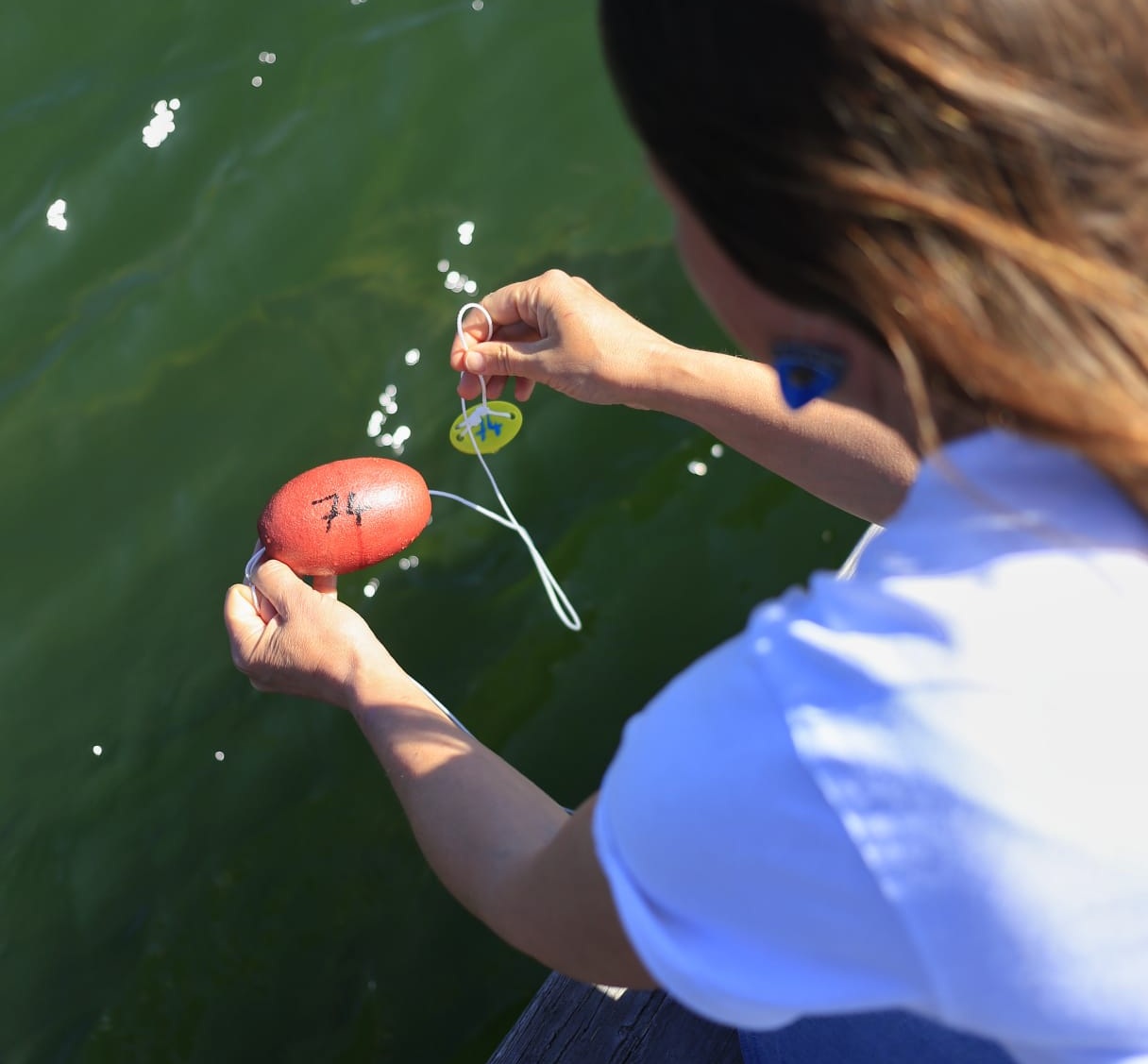
Weather Below the Surface: How Citizen Climate Detectives Are Revealing the Hidden Climate of the Sea
Text: Giannina Hattich & Christian Pansch
We talk about the weather all the time. It’s the universal icebreaker, the backdrop of our daily decisions, and something we often feel we know well. But while we carefully follow the weather in the sky, another kind of weather remains largely unseen: the weather in the sea. Thanks to a group of engaged citizen scientists, this hidden world is finally coming into focus.
The weather we know and the weather we rarely think about
The weather is everywhere. We discuss it in elevators and at coffee breaks, check forecasts before leaving home, and adjust our plans depending on sunshine, rain, or wind. Over time, we’ve become remarkably good at monitoring and understanding atmospheric weather.
But what about the weather beneath the surface? How do marine organisms deal with the weather in the sea?
During summer, many of us pay attention to sea surface temperature, mostly when deciding whether the water looks inviting enough for a swim. Yet for marine organisms, water temperature is far more than a matter of comfort. It is one of the most important drivers of biological life, influencing how fast organisms grow, how they reproduce, how they respond to stress, and whether they survive at all.
In the context of climate change, global warming has become one of the key threats to marine biodiversity. The oceans absorb more than 90 percent of the excess heat generated by global warming, and shallow seas warm particularly fast. The Baltic Sea is one such hotspot, responding rapidly to atmospheric heating. However, warming does not occur evenly, and this unevenness matters a great deal.
Just like on land: microclimates in the sea
On land, we intuitively understand microclimates. On a hot summer day, we seek shade under trees. On a windy afternoon, a sunny, sheltered corner suddenly feels much warmer and more pleasant. These small‑scale differences shape how we experience weather from one moment to the next.
Relatively similar principles apply in the ocean.
In coastal seas, water temperature can vary substantially over short distances and time periods. Sheltered bays often warm up quickly, while exposed sites influenced by wind, waves, and currents stay cooler. Water depth, bottom sediments, vegetation, and water circulation all affect how fast temperatures rise and how much they fluctuate during the day.
Despite their importance, these underwater microclimates are still poorly documented. Most monitoring systems measure temperature at a few fixed locations, often missing the fine-scale variability that marine organisms actually experience, or, conversely, are able to use when they are mobile crawlers or swimmers. I.e., ‘I go where I feel most comfortable’. Understanding the weather of the sea where life happens requires measuring more closely, more densely, and more regionally to locally.
A simple idea with great potential
The idea behind this project grew out of a long‑standing fascination with weather and temperature patterns.
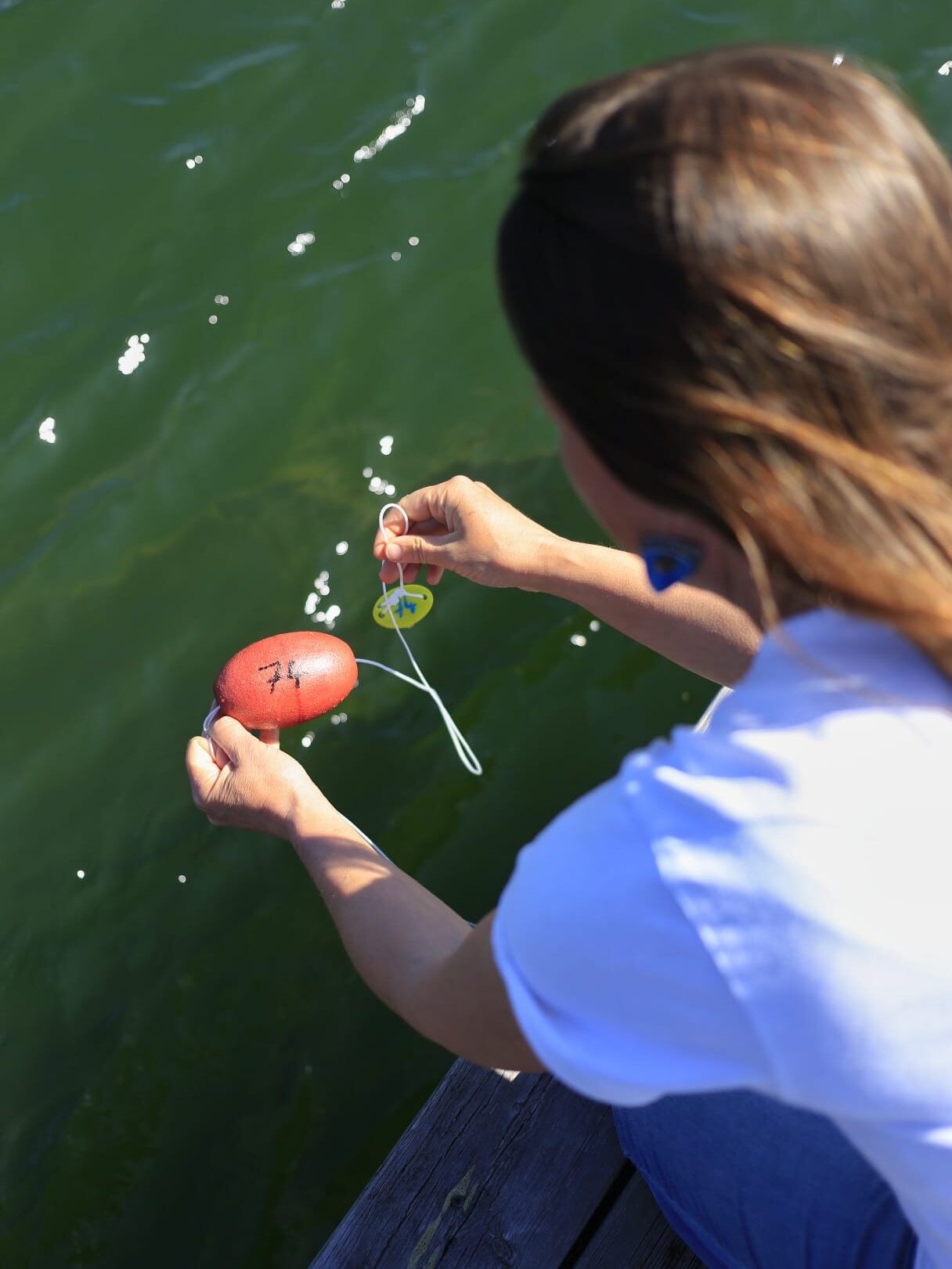
Christian Pansch, who initiated the project, describes himself as someone who has always been intrigued by weather. He keeps multiple thermometers and temperature loggers at home and rarely travels without one. For more than a decade, he has also monitored seawater temperatures using small environmental loggers that automatically record temperature every 15 minutes. Not because he likes to collect billions of data points, but because he wishes to understand what organisms and ecosystems truly experience in today’s climate, allowing us to understand how they respond in future underwater scenarios, often tested in aquarium-to-mesocosm experiments.
But there was a challenge. Deploying and retrieving these loggers, especially in remote coastal locations, takes time, effort, sometimes diving, and most importantly, one cannot be at many places at the same time. Then came a realisation: many people already care deeply about the weather, the sea, and the impacts of climate change on our local ecosystems, often visible when we go out on and into the sea.
So why not ask for help?
With this thought, the idea of a citizen science project was born. Thanks to funding from the Centre for Sustainable Ocean Science (SOS), this idea became a reality.
Many people, many loggers, one shared goal
With the SOS project funded and connected to several of our own activities, 30 temperature loggers were purchased and distributed almost immediately in 2025. The response was overwhelming.
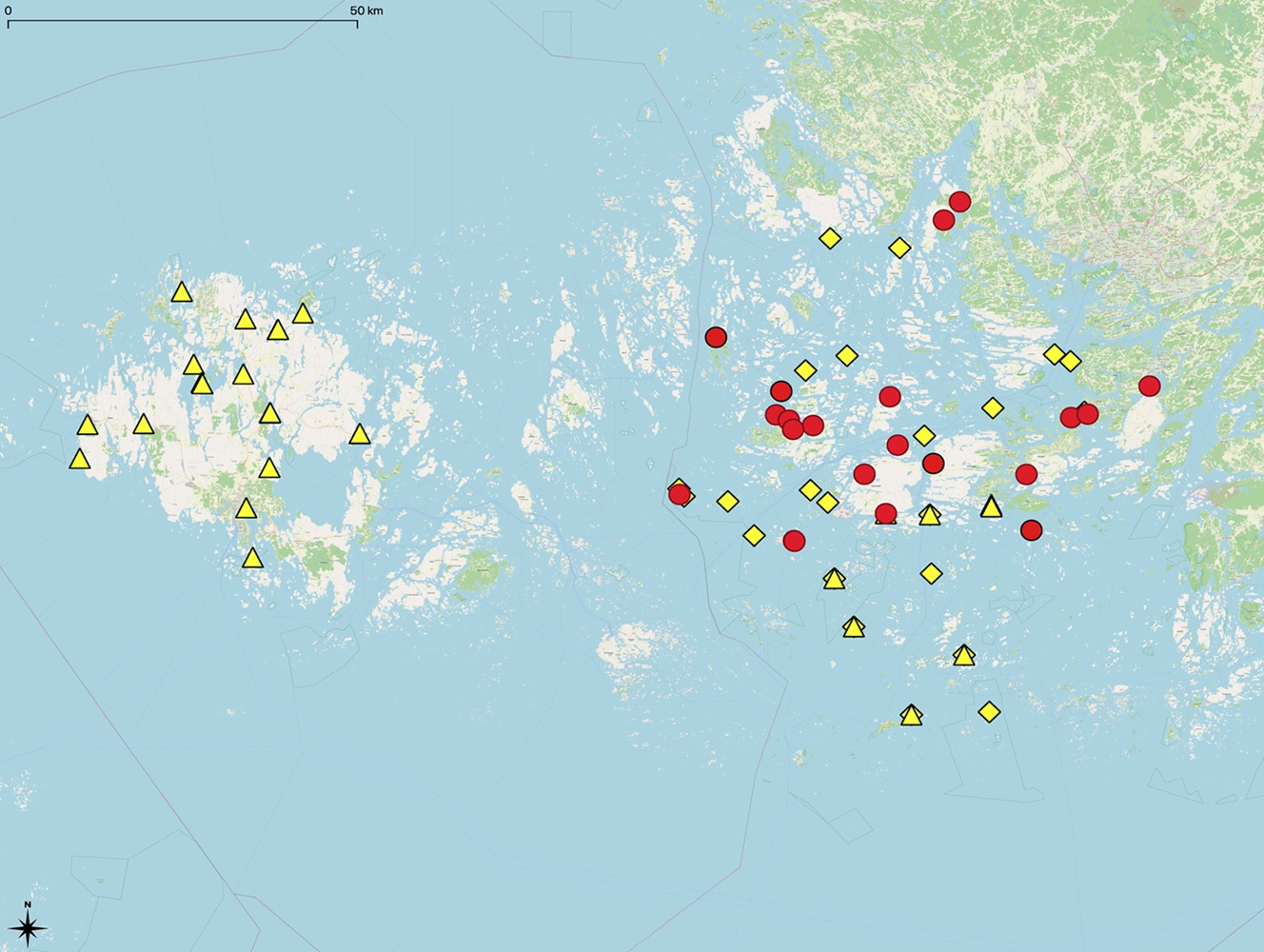
Participants placed loggers near their homes or summer houses at jetties and covered a range of coastal areas in the Archipelago Sea, from sheltered to exposed. Some volunteers installed loggers at multiple locations, while others inspired friends and neighbours to join. The enthusiasm was tangible.
As Giannina Hattich, who coordinates the project, recalls, it was deeply motivating to see how engaged everyone was. People didn’t just deploy loggers; they actively followed the project, shared experiences, and expressed genuine curiosity about the data and how they would be used in scientific research.
From a practical standpoint, the project was also a success. Only a few loggers were lost at sea, one failed to record properly, and several were never deployed. Overall, 17 loggers returned high-quality datasets, a remarkable outcome for a first citizen science effort of this kind in the area.
What the data revealed
Even with this initial dataset, clear patterns emerged.
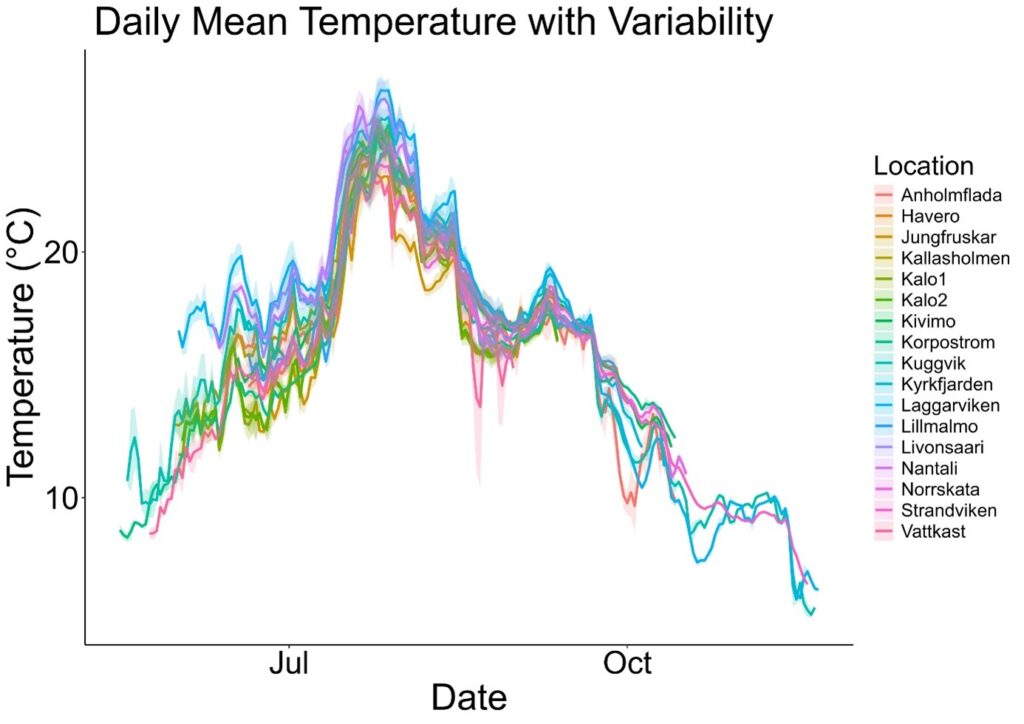
Differences in temperature between sites were strongest in early spring, when warming begins, and local conditions strongly influence how quickly the water heats up. This suggests that the early season may be a particularly important period for shaping biological responses.
During August, when all loggers were deployed simultaneously, direct comparisons between sites became possible. The results were striking. Mean water temperatures differed by more than 3 °C between the warmest and coldest locations. Daily temperature variability also varied widely. Some places experienced relatively stable conditions, while others showed large swings between cool and warm temperatures within a single day.
These differences may sound small, but for marine organisms they can be decisive. A few degrees can influence whether an organism thrives, becomes stressed, or reaches its tolerance limit. The data clearly show that coastal organisms live in a patchwork of thermal environments, not in a single, average-temperature sea.
Why continuing the measurements matters
The results raised as many questions as they answered. One key insight was that temperature differences appear to be strongest early in the year, even before summer begins. This makes spring an especially important period to study.
To fully understand how and when these microclimates develop, earlier‑season data are needed. Repeating measurements across multiple years will also allow researchers to determine whether observed patterns are consistent or change during particularly warm summers or marine heatwaves, as these events may occur in different seasons in different years.
The good news is that a large regional infrastructure fund from the Finnish Research Council is available within the collaborative project NEMESIS to continue the project this year and potentially for the next two years as well. Continued participation, especially early in the season, would provide invaluable insights into how marine microclimates evolve over time.
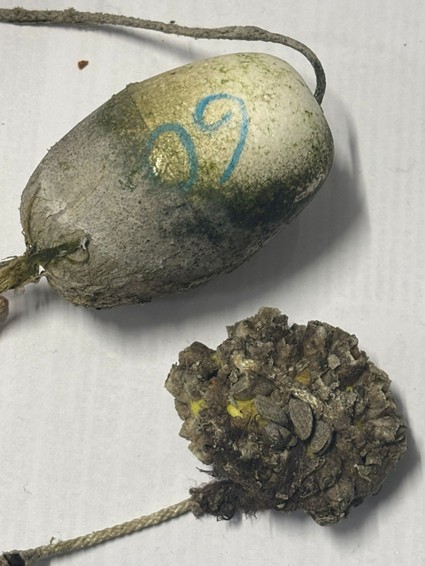
Revealing the hidden climate of the sea
This project shows what can happen when scientific curiosity meets public engagement. By working together, researchers and citizens can collect data at a resolution that would otherwise be impossible.
Marine microclimates remind us that climate change is not just about global averages. It is about local conditions, lived experiences, and small-scale variability in the sea as much as on land. Thanks to many dedicated climate detectives, the weather below the surface is no longer entirely hidden.
And as our climate continues to change, understanding these hidden patterns may prove to be more important than ever.
Become a marine climate detective
If you live near the Archipelago Sea’s water line and are curious about the marine environment, we warmly invite you to join our growing team of Marine Climate Detectives. Whether you can deploy a temperature logger, help document local conditions, or simply follow and share the results, your involvement makes a real difference.
Learn more about the project here.
To participate, fill out this form.
You can also contact us directly:
Giannina Hattich: giannina.hattich@abo.fi
Alexandra Jensen: alexandra.jensen@abo.fi
Further reading on marine heatwaves in the Archipelago Sea
Authors
Giannina Hattich, Research Technician, Åbo Akademi University
Christian Pansch, Professor of Marine Ecology, Åbo Akademi University