
The birth of the Whale Farmer project
Text & images: Vespa Laine, Riikka Puntila-Dodd & Conny Sjöqvist
A Whale Farmer is a term for a person who, despite their environmental concerns, is an active protector and enforcer of the marine environment.
Whale Farmer is a spin-off science and art research project from the MIMOSA project (Modeling Advanced Primary Production Scenarios in Coastal Seas) that was awarded booster funding through the Åbo Akademi University Centre for Sustainable Ocean Science (SOS) Project Booster 2024 program. The research incorporated evolutionary data obtained from microalgae and modeled contrasting future scenarios in the Archipelago Sea using a biogeochemical model FICOS. Fern Orchestra’s sound designer-composer Markus Heino and artist Vespa Laine worked on the MIMOSA project, following the scientific research of Conny Sjöqvist and Riikka Puntila-Dodd. This collaboration led to the Whale Farmer project, which will now continue in 2026–27.
Whales are mechanical water mixers in the oceans, ensuring that water masses continue to mix. Mixing of water layers is an essential prerequisite for a functional marine ecosystem. As the climate is warming, the temperature of the surface water continues to rise, which leads to strong vertical differences of water temperatures in the ocean and decreases mixing of cold, nutrient-rich water and warmer surface waters. This leads to detrimental effects on the marine food web. The situation calls for a greater need for active mixers in the global ocean. Hence, in the Whale Farmer-project, whales are symbolic animals for alleviating the negative effects of ongoing global warming.
Primary production in the world’s oceans is largely sustained by single-celled microalgae inhabiting the surface waters where there is enough light for photosynthesis. Microalgae absorb carbon dioxide from the atmosphere and convert it into energy that forms the basis of the entire marine food web. At the same time, they produce approximately 50% of the Earth’s oxygen, which sustains life on Earth as we know it today. However, global models and measurements show an ongoing decline in primary production because of intensifying vertical stratification of water masses. It is estimated that primary production by microalgae has already decreased by about 5% since the 1850s. A decreasing trend is expected to accelerate in the future as warming progress and microalgae in the surface water are not being supplied with nutrients from deeper waters.
However, current models do not include any evolution of organisms that can buffer against changes. It means that the future scenarios we are discussing today are not built on all necessary data to provide an accurate understanding of the future marine food web. Our scientific goal is to develop current modeling tools and to incorporate the role of evolutionary adaptation in primary producers to create more realistic future scenarios. The coastal modeling system, FICOS, was originally developed at the Finnish Environment Institute and is used in planning, impact assessment, and monitoring of water management measures. In the Archipelago Sea, the model can also be used to calculate and compare the effects of changes in load on coastal water quality or primary production. In this way, it is possible to calculate the impact of changes in primary production on the structure and function of the entire ecosystem, for example, on fish and fishing. FICOS has also been used experimentally for climate change projections in previous projects. Previous results show that eutrophication in the Archipelago Sea is a persistent problem due to high internal loading.
However, longer 100-year forecasts that assume a reduction in nutrient loading show a marked decrease in primary production, which may have consequences for the overall productivity of the system. By using resurrected microalgae from the Archipelago Sea from different decades (the 1960s, 1990s, 2010s), we have previously shown that a key species has adapted to rising sea temperatures. This discovery was based on natural evolution and provides the most accurate estimate of the pace of evolution during the historical warming that has already occurred in the Archipelago Sea. It showed that microalgae can adapt to warming, i.e. increase their temperature optima, by about 1°C in 50 years. This also gave us access to new data for developing the biogeochemical model for the Archipelago Sea, which is currently based on the static tolerance of species in terms of temperature, meaning it does not consider evolution in microalgae as a factor. In our research we have tweaked the model to make use of evolutionary information. With the developed modeling, we have tested different scenarios and their impact on the ecosystem. Our preliminary results show that the role of microalgae adaptation to temperature increase in the Archipelago Sea ecosystem is minimal. The minor effects incurred from evolution are likely overridden by the fact that the Archipelago Sea system is highly driven by nutrient conditions. The role of nutrient level adaptation as well as identifying compensatory mechanisms in the food web are the scientific goals of the Whale Farmer project.
To increase societal relevance of marine ecology research, we must first understand how people perceive the scientific results. Thus, the role of artists is not only to make the results of scientific research accessible to as wide an audience as possible, but also to activate the audience to work for a better future. Knowing that we are part of the problem creates a feeling of shame, a passive emotion. There is a wealth of information available, yet it does not seem to influence decision-making. Through physical experience, people can internalize information more deeply and shape their worldview, leading to action.
Whale Farmer is a project that presents scientific results to the people of Turku in June 2026 using art. In the event, we will visualize research data and provide an opportunity to discuss the future of the oceans with scientists and artists. A central location in Turku will feature a three-dimensional textile sculpture called Keijusto, crocheted from algae yarn and spanning the public space, where anyone can come and crochet. The Whale Farmer week will culminate in a community dance performance called Keijunta, which will take place inside and around the textile sculpture.
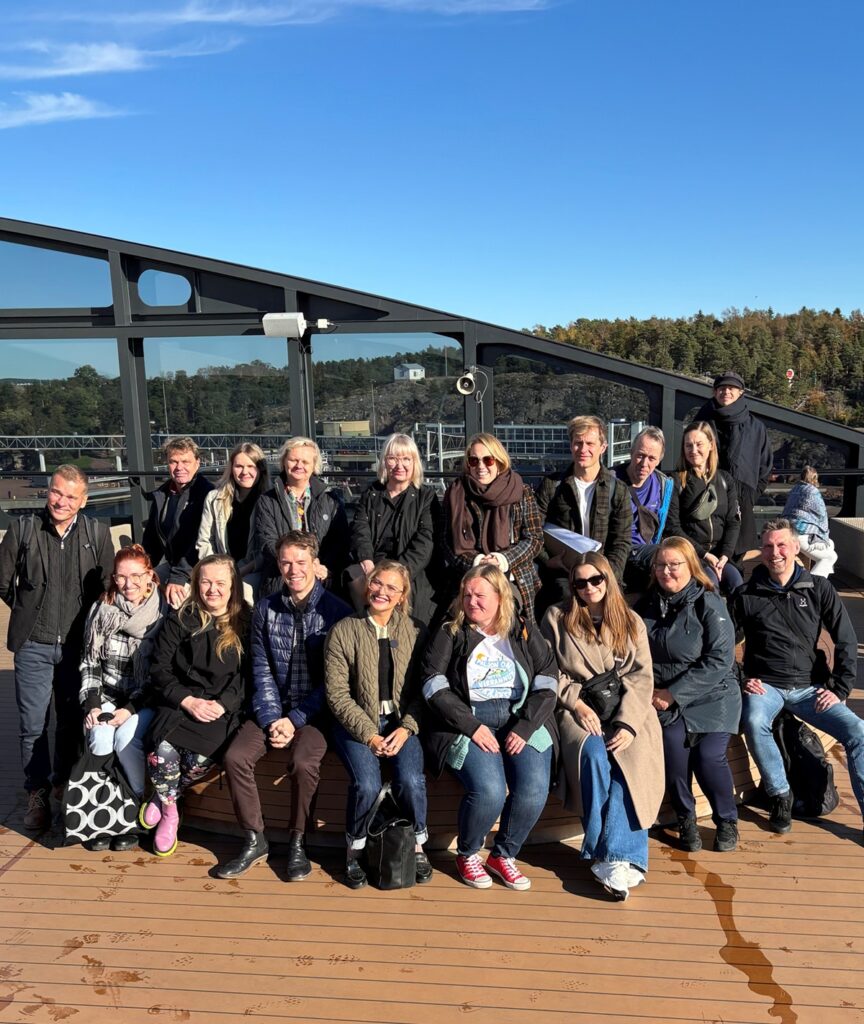
During the MIMOSA project, we organized a “training programme” for Whale Farmers, to which we invited a wide range of people from different backgrounds, not only to hear about the scientific results, but also collectively imagine the future. An artist’s most powerful tool is imagination, and it often feels as if we are discussing money instead of ideas. When we talk about environmental policy, we are talking about money. This can limit our thinking, which is why we wanted to focus the training session on imagining a future in which all of the world’s resources are available. The working groups came up with some amazing ideas for saving the Baltic Sea – hopefully we will hear more about these later! The Whale Farmers will continue to grow, work together on future projects, and fight for the marine environment.
Link to the web page: https://fernorchestra.com/en/photography/valaankasvattaja
Authors
Vespa Laine, Artist, Fern Orchestra
Riikka Puntila-Dodd, Project Researcher, Åbo Akademi University
Conny Sjöqvist, Project Researcher, SOS, Åbo Akademi University