
Field reflections from training Finnish asylum officials
Refugee status determination is considered a difficult task for asylum officials, considering that many asylum applicants do not have documentary evidence. Previously, researchers have found that asylum officials mostly asked closed and yes/no questions during the interview. This questioning approach affects, for example, the production of a detailed statement with subsequently hurts the credibility of asylum seekers. Also, research has shown that there are various communication challenges between asylum seekers and officials. Lastly, researchers have highlighted the challenges in relying on certain criteria, such as detailedness and plausibility, in credibility assessment.
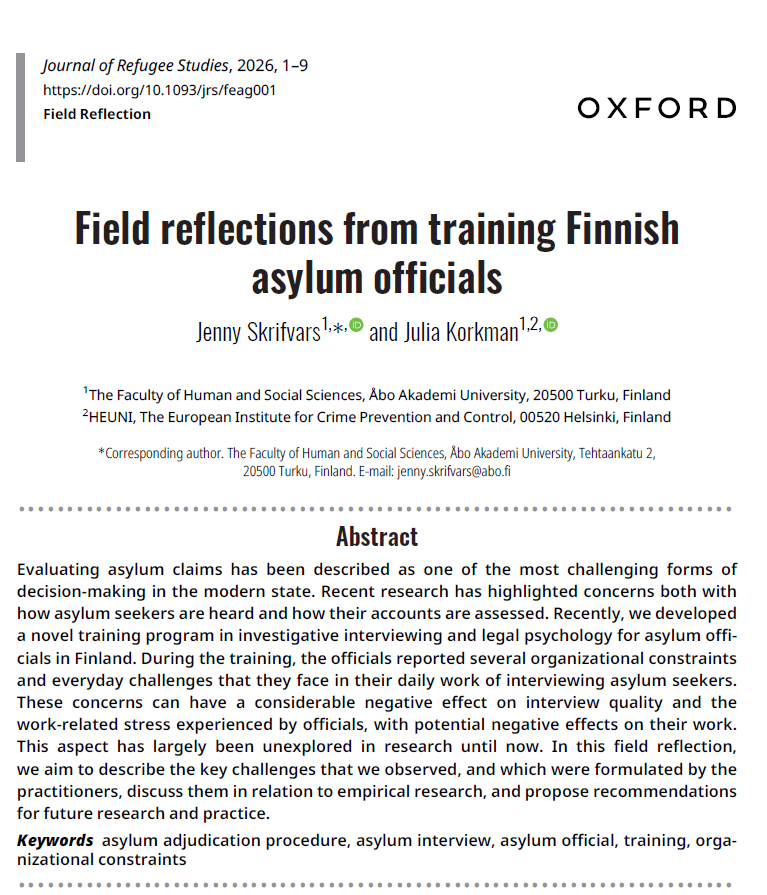
Considering these challenges in the asylum context, Dr. Jenny Skrifvars, Prof. Jan Anfolk and Prof. Julia Korkman from the Psych-AID research team organised a training program in legal psychology for Finnish asylum officials. The training covered topics such as memory, the impact of trauma and cultural background on memory and others. This training was shown to be very effective (read more on the training here). In the current article, Dr Jenny Skrifvars and Prof. Julia Korkman reflected on the supervisions and seminars, and their personal observations during the training program.
In the published field reflection, Dr. Jenny Skrifvars and Prof. Julia Korkman aimed to describe the everyday challenges and organisational constraints reported by Finnish asylum officials during the training. The reflection aimed to discuss the areas of concern in relation to empirical literature and proposed solutions and recommendations for future practice and research. Some challenges that they raised in the paper concerned the high workload during interviews, which resulted from a lack of a well-structured interview protocol. They discussed issues with the physical environment where the interviews were conducted, which could hurt rapport building. They noted that though online interviews provided flexibility in where interviews could be conducted, online interviews could hurt the establishment of rapport, and they raised issues with internet connectivity. Also, during online interviews, the official may not be able to provide any support where the asylum seeker experiences very strong negative emotions. In addition, they highlighted challenges officials encountered with legal representatives and interpreters. Finally, they highlighted the challenges with questioning techniques, as some officials did not know how to handle asylum seekers who either talked too little or too much. They provided very practical solutions, such as training officials on how to establish rapport, the use of the model statements in interviews, making the interview environment very conducive and working with trained translators.