
Recent Activities

Upcoming event: Conference on SOGI and asylum decision-making, October 2026
Conference on “Sexual Orientation and Gender Identity (SOGI) in Asylum Decision-Making: Towards an Infrastructure for Evidence-Based Practice.” Where: Turku, Finland When: 15–17 October 2026

Dr Dilhan Töredi awarded an Early Career Grant by the American Psychology-Law Society
Dr Dilhan Töredi has been awarded the Grant-in-Aid for Early Career Professionals by the American Psychology-Law Society. The grant will enable her to undertake a study which aims to disentangle the effects of trust and confidentiality concerns from those arising from interpretation quality and other cross-cultural influences in interpreter-mediated asylum interviews. The study will employ an empirical investigation using AI as a methodological tool to isolate and examine these influences.
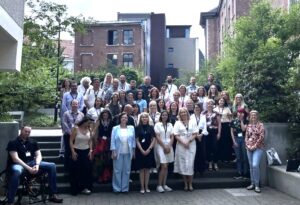
Psych-AID at the International Investigative Interviewing Research Group Conference 2026
The Psych-AID Network attended the International Investigative Interviewing Research Group (iIIRG) Conference 2026, held at KU Leuven in Belgium. A central theme of the conference was the practical implementation of the Méndez Principles and efforts to bridge the gap between best-practice guidance and real-world interviewing practices. Members of Psych-AID presented their research on various topics, and one member received the Best Student Poster Award in recognition of the originality and quality of her work.
Recent Publications
Attitudes towards immigration explain beliefs about asylum authorities and their decisions
The current Psych-Aid project examined how personal immigration attitudes shape beliefs about asylum authorities and their decisions, and how these beliefs reflect well-established gender and age differences. Consistent with motivated cognition theory, the findings suggested that ideological beliefs shape how individuals perceive and evaluate the asylum system. Rather than being based solely on factual information, perceptions of asylum procedures and outcomes may be influenced by underlying ideologically motivated beliefs.
An Experimental Test of Stereotype Congruency in Credibility Assessments of Sexual Orientation Asylum Claims
In this Psych-Aid project, Malin Ekelund, together with Jenny Skrifvars, Hedayat Selim, and Jan Antfolk, sought to better understand the psychological mechanisms underlying credibility assessments in sexual orientation asylum claims. To investigate this, they conducted an experiment examining whether stereotype congruence—that is, the extent to which an applicant appeared consistent or inconsistent with stereotypes associated with gay men and lesbian women—influenced credibility judgements.